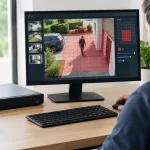
A recorder can either simplify a surveillance project or create limits that show up the moment a customer asks for one more camera, better nighttime detail, or remote access from another location. The decision between NVR versus DVR systems affects cabling, camera selection, image quality, expansion options, and the service work required over the life of the installation.
For a small retrofit, a DVR may be the practical choice. For a new commercial build, an NVR often gives installers and property owners more room to grow. The right answer depends on the existing infrastructure, required coverage, budget, network capacity, and how the site will be managed after installation.
NVR Versus DVR Systems: The Core Difference
A DVR, or digital video recorder, is generally used with analog security cameras. Modern analog HD camera systems can still deliver high-resolution video, but the camera sends its signal to the recorder through coaxial cable. The DVR processes and encodes the video before storing it on a hard drive.
An NVR, or network video recorder, works with IP cameras. Each IP camera processes video at the camera level and sends digital footage across an Ethernet network to the NVR. In many installations, a single Cat5e or Cat6 cable can provide both network connectivity and power through Power over Ethernet, or PoE.
That difference has real installation consequences. DVR systems typically require separate power runs for cameras unless the installer is using a power-over-coax approach. NVR systems can reduce cable clutter and centralize power at a PoE switch or an NVR with built-in PoE ports. However, NVR installations require proper network planning. A weak switch, undersized uplink, or poorly organized network can affect camera performance across the site.
When a DVR System Makes Sense
DVR systems remain a strong fit for existing properties with coax already in place. Reusing functional cable can save substantial labor on retail, residential, office, and small warehouse upgrades. Instead of opening walls or running new Ethernet cable, an installer can replace older analog cameras with compatible HD-over-coax models and install a current DVR.
This approach can be especially effective when the customer needs dependable coverage at a controlled cost. A small business that wants clear video at cash registers, entrances, delivery doors, and parking areas may not need the flexibility of a fully networked IP system. A properly matched DVR, cameras, hard drives, and power supply can provide reliable recording without a major infrastructure overhaul.
DVRs also keep the camera traffic largely off the customer’s data network. That can be useful at sites where the business network is unmanaged, congested, or controlled by a third-party IT provider. The recorder handles the camera inputs directly, reducing the need to coordinate camera bandwidth with office workstations, WiFi devices, POS terminals, and other network equipment.
The trade-off is expansion. Coax runs are tied to the DVR’s physical channel count, and adding cameras can require more cable, additional power capacity, and a larger recorder. Camera feature choices may also be narrower than with IP systems, particularly when a project calls for advanced analytics, specialized AI detection, high-resolution panoramic coverage, or broad third-party integration.
Where NVR Systems Pull Ahead
NVR systems are usually the better choice for new construction, larger properties, and sites that need to expand over time. IP cameras are available in a wide range of resolutions, form factors, lenses, low-light technologies, full-color options, PTZ capabilities, and smart detection features. This gives installers more precision when designing coverage for loading docks, building perimeters, apartment communities, school campuses, and multi-location businesses.
PoE is a major operational advantage. One Ethernet cable can carry power and data to the camera, which simplifies installation and makes troubleshooting more direct. A technician can verify link status, power delivery, camera IP addressing, and video transmission from the network side instead of tracing separate video and power circuits.
NVR systems also support more flexible placement. Cameras can connect to an NVR’s built-in PoE ports, a local PoE switch, or a managed network switch elsewhere on the property. That is useful when cameras are spread across multiple buildings, floors, or exterior zones. With the correct switching, uplinks, and network segmentation, an IP system can extend far beyond the physical reach of a single recorder.
For customers who need centralized management, IP systems are often easier to scale. A property manager may want to review cameras at several locations, while an integrator may need to combine surveillance with access control, intercoms, network infrastructure, and remote health monitoring. NVR-based systems are generally better positioned for these connected deployments.
That flexibility does not eliminate planning requirements. Every IP camera consumes bandwidth and storage. Higher resolutions, higher frame rates, continuous recording, audio, and AI features can increase demand quickly. An NVR project should include a realistic review of switch capacity, PoE power budget, uplink speeds, hard drive size, retention targets, and remote viewing needs.
Image Quality Is Not Just an NVR Advantage
It is common to assume that NVR systems always produce better footage than DVR systems. The more accurate answer is that image quality depends on the camera, lens, sensor, lighting, compression settings, and scene conditions.
A modern analog HD camera connected to a quality DVR can provide very usable footage for general surveillance. It may be more than sufficient for identifying activity at an entryway, monitoring a sales floor, or reviewing an incident near a driveway. For many retrofit projects, the ability to reuse coax is more valuable than moving to a different platform.
IP cameras, however, typically offer a broader path to higher resolutions and specialized performance. A properly selected IP camera can provide crystal-clear footage over a wide scene, better digital zoom during playback, enhanced WDR for entrances with harsh backlighting, and stronger low-light visibility. Full-color cameras with supplemental lighting can also improve the usefulness of nighttime evidence where ambient light is limited.
The right question is not, “Which recorder has better video?” Ask what the customer needs to identify. License plates at a gate, faces at a front door, inventory movement in a warehouse aisle, and activity in a dark parking area all require different camera placement and performance priorities.
Installation and Support Considerations
For installers, the best system is the one that can be deployed cleanly, serviced efficiently, and supported years later. DVR systems are straightforward when the coax infrastructure is labeled, tested, and in good condition. Before committing to a DVR upgrade, test every cable run. Old coax may have hidden splices, water damage, poor connectors, or distance-related signal loss that reduces performance.
NVR installations call for a different discipline. Assigning IP addresses, setting strong passwords, updating firmware, configuring remote access, and separating camera traffic from business traffic are part of a professional deployment. Managed PoE switches can provide useful visibility, especially on larger sites where a failed camera may be caused by power draw, port issues, cable damage, or network configuration.
Compatibility should be checked before equipment is purchased. Not every IP camera works equally well with every NVR, even when ONVIF support is available. Using a matched recorder and camera platform typically provides more dependable access to motion detection, smart events, audio, two-way communication, PTZ control, and remote app features. Third-party integration can be valuable, but it should be tested against the features the customer actually expects to use.
Storage Planning Can Change the Recommendation
Hard drive capacity is often treated as an afterthought, then becomes a problem when critical footage is overwritten earlier than expected. Both NVR and DVR systems need storage planning based on camera count, resolution, frame rate, compression, activity level, and required retention period.
Continuous recording provides the most complete record, but it uses more storage. Motion recording can extend retention, although poorly configured motion settings can produce false alerts and unnecessary recordings from shadows, rain, headlights, trees, or moving displays. Smart detection can reduce that noise by focusing on people, vehicles, or selected zones, but its effectiveness depends on camera placement and configuration.
For commercial customers, clarify retention requirements before selecting the recorder. A convenience store may need several weeks of footage. A school, healthcare facility, or industrial site may need longer retention, more cameras, or redundant recording options. Choosing a recorder with enough drive bays and expansion capacity can prevent a premature replacement later.
Choosing the Right Recorder for the Job
Choose a DVR when the site has usable coax, the camera count is relatively fixed, and the goal is a cost-effective upgrade with dependable local recording. It is a practical option for many homes and small businesses that need a clear improvement over outdated analog equipment without a complete recabling project.
Choose an NVR when the project is new, expanding, spread across a larger property, or dependent on IP camera features and centralized management. It is typically the better platform for customers who want flexible camera placement, advanced analytics, higher-resolution options, and a system that can grow with their operation.
Worldstar can help match cameras, recorders, PoE switches, hard drives, cabling, and installation requirements into one complete surveillance plan. Start with the site conditions, define what must be captured, and select the platform that will still meet the customer’s needs after the next expansion.
Security installers and integrators: WorldStar offers dealer pricing on security cameras, NVRs, and DVRs, with private-label options and lifetime technical support.