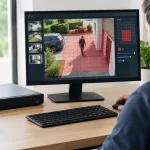
A camera location can be perfect for coverage and still be difficult to wire. Gates, parking lots, detached buildings, loading areas, and long exterior walls often sit beyond the standard Ethernet run from the network closet. The best PoE extenders for cameras solve that distance problem without adding a local AC outlet, but only when the extender, cable, switch, and camera power requirements are planned as one system.
For security installers and property managers, the goal is not simply to make a camera turn on. The goal is stable video, adequate power for night operation and PTZ movement, and an installation that remains serviceable after weather, cable aging, and future expansion. That is why extender selection should start with the actual camera load and route length, not the lowest advertised price.
What a PoE Extender Does for a Camera System
A Power over Ethernet extender receives network data and DC power over a Cat5e or Cat6 cable, then forwards both to a camera or another extender. Standard copper Ethernet channels are normally limited to 328 feet, or 100 meters, per segment. An extender creates another cable segment, allowing the installer to reach a remote camera without placing a power supply at the far end.
Most surveillance extenders are designed for point-to-point use. A PoE switch feeds the first cable run, the extender sits in a junction box, pole enclosure, or protected service location, and a second cable runs to the IP camera. Certain models also support cascading, where two or more extenders are installed in sequence. Cascading can be useful across a large property, but every added device reduces the available power at the endpoint and creates another connection to inspect during service.
An extender does not create power. It passes along a portion of the power supplied by the switch or injector. This distinction matters most with PTZ cameras, cameras with heaters, multi-sensor cameras, and full-color cameras that use supplemental lighting at night.
Best PoE Extenders for Cameras: Match the Type to the Job
There is no single best extender for every surveillance project. The right choice depends on distance, camera wattage, environment, and whether the endpoint needs one camera or multiple devices.
Single-Port PoE Extenders for Standard Fixed Cameras
A single-port extender is usually the cleanest option for one fixed dome, turret, or bullet camera placed just beyond the normal Ethernet limit. These compact units are practical for exterior soffits, long warehouse aisles, perimeter fencing, and detached garages.
Choose a unit that clearly states its supported input and output PoE standard. For a typical fixed camera, an IEEE 802.3af extender and switch may be sufficient. If the camera uses strong IR illumination, white light, or a motorized lens, step up to 802.3at capability and confirm the remaining output wattage at the intended distance.
The benefit is simple installation. One cable supplies the extender, and the extender supplies the camera. The trade-off is that a single-port unit does not leave capacity for an additional camera, access point, or intercom at that location.
High-Power PoE+ Extenders for PTZ and Illuminated Cameras
PoE+ extenders are the better fit where a camera has a higher startup or operating demand. A PTZ can draw more power while moving, and long-range IR, active deterrence lighting, heaters, and wipers all increase the endpoint requirement.
Look beyond a label that says “PoE+.” Review the specified output budget after cable loss. A switch might provide up to 30 watts at its port, but the camera will receive less after the first cable run, extender electronics, and second cable run. If a camera needs 20 watts during nighttime operation, a design that delivers only 16 watts will cause intermittent reboots or disabled functions.
For demanding perimeter applications, use a managed PoE+ switch with sufficient total system budget. This makes it easier to see port status, identify a power fault, and restart a remote camera without rolling a truck.
Long-Range PoE Extenders for Perimeter Coverage
Long-range PoE extenders are designed for installations where the endpoint may be several hundred feet or more from the switch. They are common for parking areas, agricultural sites, storage yards, long driveways, and campus-style properties.
Distance claims should always be read with the fine print. Some devices quote maximum reach only when paired with a low-power camera, reduced data rates, or a specific cable type. A 4K camera may require more bandwidth and power than a basic 1080p fixed camera, especially if it records at a higher frame rate or uses advanced analytics.
Use solid-copper Cat5e or Cat6 cable for these runs. Copper-clad aluminum cable creates higher resistance, greater voltage loss, and unreliable results over distance. It may appear to work during daytime testing and fail once IR LEDs or white-light illumination activate after dark.
Outdoor and Surge-Protected Extenders for Exposed Routes
For pole mounts, gates, exterior walls, and building-to-building pathways, an indoor extender placed in an unsealed box is a weak point. Select an outdoor-rated enclosure or an extender designed for the expected temperature, moisture, and mounting conditions.
Surge protection is equally important for exposed copper runs. A nearby lightning event or electrical transient can damage a camera, extender, switch port, or all three. Protection should be properly grounded and installed at the right points in the cable path. It reduces risk but does not replace correct bonding practices or eliminate the advantages of fiber where electrical isolation is needed.
When a cable crosses between buildings or runs through an area with frequent electrical activity, fiber with a remote PoE switch is often the better engineering decision. It costs more upfront but separates the buildings electrically and supports much longer distances.
Multi-Port PoE Extenders for Small Remote Clusters
A multi-port extender can feed several low-power cameras from one uplink. This works well for a small group of cameras at a gatehouse, a loading dock, a parking-lot entrance, or a remote corner of a warehouse.
The key limitation is shared power. If the uplink delivers a fixed power budget and the extender divides it among four ports, each connected device competes for that budget. Four low-wattage fixed cameras may operate correctly, while two PTZ cameras and two active-deterrence cameras may exceed capacity immediately.
Multi-port extenders also require a clear plan for bandwidth. Multiple cameras sharing one uplink can be appropriate for moderate bit rates, but high-resolution cameras with continuous recording should be calculated carefully. A managed switch and recorder with appropriate throughput prevent the remote cluster from becoming a bottleneck.
Calculate Power Before Selecting an Extender
Start with the camera data sheet. Identify typical power draw, maximum power draw, and the required PoE standard. Maximum draw is the number that protects the installation, because it accounts for night mode, motors, heaters, and other features that may not operate during a quick bench test.
Next, account for the source. Check both the PoE capability of the individual switch port and the total power budget of the switch. A 16-port PoE+ switch may not provide maximum PoE+ power on every port at the same time. If multiple cameras switch to IR at sunset, the total demand can rise quickly.
Then consider the route. Longer cable runs have more voltage drop, and each extender consumes a small amount of power for its own operation. Leave power headroom rather than designing at the exact stated maximum. A practical margin helps the system tolerate cable variation, colder weather, and feature changes later.
Confirm Standards, Speed, and Recorder Compatibility
For most current IP camera installations, use standards-based equipment that supports IEEE 802.3af, 802.3at, or 802.3bt as required. Avoid passive PoE devices unless every component is specifically designed for the same passive voltage and pinout. Mixing passive equipment with standards-based cameras can damage hardware.
Also verify network speed. Many surveillance extenders use 10/100 Mbps Ethernet, which is adequate for one or several modest-stream cameras but can be limiting in high-resolution installations. If the route serves multiple 4K cameras, an access point, or a remote switch, confirm whether gigabit throughput is required.
The extender generally does not need special compatibility with the NVR. It must reliably pass network traffic between the camera and network. However, camera discovery, plug-and-play provisioning, VLAN use, and PoE watchdog functions can vary by switch and recorder design. Test the complete path before final mounting, especially when using third-party devices.
Installation Practices That Prevent Service Calls
Mount extenders where technicians can reach them without dismantling a ceiling or climbing a pole whenever possible. Use weather-rated junction boxes outdoors, seal cable entries, form drip loops, and label both sides of every extended run. Documentation matters when the system is expanded two years later.
Keep cable terminations clean and consistent. Poorly crimped RJ45 connectors, water intrusion, and low-grade cable create symptoms that resemble camera or NVR failures. A cable tester can identify basic wiring faults, while a PoE tester can verify voltage, class, and live power draw at the camera end.
Before closing the enclosure, test the camera in its highest-demand condition. Move the PTZ, activate illumination, view the live stream at the required resolution, and confirm recording at the NVR. A camera that stays online only under daytime idle conditions is not ready for deployment.
For installers building a new system or extending an existing one, Worldstar can help match cameras, PoE switches, cabling, and network hardware to the actual site plan. The best result is a complete power-and-network design that gives every camera stable operation from the first night onward.
A well-chosen PoE extender turns a difficult camera location into usable coverage. Plan for the maximum load, protect exposed cable routes, and leave enough headroom that the system keeps delivering crystal-clear footage when conditions are at their toughest.